We often talk about careers as if they’re linear. We call them “ladders,” we talk about “climbing the ranks” and “moving up.” All of these metaphors imply the same thing: that careers should always be in growth mode and always moving in a straight, upward direction.
But that’s simply not accurate for most people.
Sheryl Sandberg once described careers as a “jungle gym,” which is certainly a more realistic visual. But even then – what’s really behind the story as we climb the wall, traverse the monkey bars, and take the zipline to the next structure?
A huge part of why careers don’t feel linear (and why they aren’t) is because throughout our lives, we move through different seasons.
Like natural seasons, our career seasons are cyclical. This is important, because when you’re in a season that feels heavy or stagnant, it’s easy to assume it’s your new reality – that this is who you are now. But seasons are normal. They are not signs of failure or negativity. They simply reflect your energy levels, your identity, your priorities, and your values at that moment in time.
Even in our “best” seasons – however we personally define “best” – we don’t stay there forever. And we shouldn’t. How dull, truly, would it be if our careers stayed exactly the same from day one until retirement?
Our seasons often correspond to chapters in our lives: becoming a parent, caregiving, going through burnout, pursuing further education, entering entrepreneurship, moving countries, or taking on a promotion. A season is simply data – information that, if we work with it rather than against it, helps us build a more aligned career and mitigate unnecessary tension.
The Four Seasons
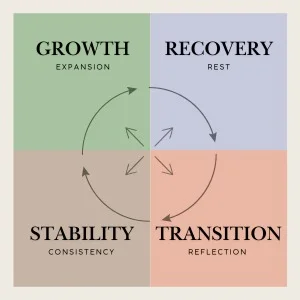
Growth Season
The season of high energy and high ambition. In Growth Season, you feel ready for challenge, excited by possibility, and motivated to take on more. This is when you lean into stretch goals, build new skills, and feel momentum. It’s an invigorating season.
Notable actions:
• Saying yes to new opportunities
• Mapping out long-term career moves
The risks?
Growth takes a lot from us. When we push to stay in this season too long, we run the risk of overextending, ignoring fatigue, and ultimately hitting burnout – which often requires more recovery time than we expect.
Recovery Season
Often (but not always) following a period of intense growth, this is the season when your mind, body, and spirit need rest. Recovery can follow burnout, exhaustion, or general depletion – mentally, physically, or both.
The frustrating part of this season is that it can feel like failure or a loss of ambition. Slowing down can trick us into believing that we “no longer have what it takes,” when in reality, this is simply a period of recalibration. When embraced, Recovery Season becomes a time of deep introspection, realignment, and rebuilding.
Notable actions:
• Rest and rebuild – emotionally and physically
• Set small, gentle goals
• Rebuild confidence
• See this season as essential, not indulgent
The risks?
If we ignore or push past this season, we’re likely to experience shame, guilt, or the sense that we’re “not enough.” We compare ourselves to past versions – operating in Growth Season and judge ourselves unfairly.
Transition Season
This season feels like being on the edge of your seat – you sense something shifting but don’t yet know what the next chapter looks like. You may feel restless, curious, or aware you’re outgrowing something. Transition Season is exploration mode.
This is where you gather information, reflect on your past, and envision possibilities for the future. It is the natural precursor to pivots, realignments, or major decisions.
Notable actions:
• Gathering data
• Exploring and networking
• Reflecting and assessing before making a big jump
The risks?
Analysis paralysis. This is when dreaming replaces doing, or when gathering data becomes a way of avoiding decisions. Doubt creeps in, perfectionism takes over, and fear of choosing “wrong” stalls progress.
Stability Season
This is the season of maintenance. It often appears when life outside of work demands more from us – becoming a parent, caregiving, health challenges, or simply a phase where other aspects of life take precedence.
In Stability Season, you crave consistency, routine, and predictability. You maintain performance, establish boundaries, and ensure your energy is protected. This season is about balance and sustainability.
Notable actions:
• Protecting boundaries
• Strategically saying “no”
• Making decisions based on sustainability
The risks?
Guilt. Feeling “slow” or “behind” because you’re not pushing as hard as before – even though this season requires a different pace.
The four career seasons can happen sequentially, but they don’t have to. You can move directly from one to another; it doesn’t always follow a neat cycle. The most important piece is understanding what season you are actually in – and then giving yourself what you need to thrive there.
Why Misalignment Happens
The simplest explanation for misalignment is this:
You’re operating in a way that doesn’t match the season you’re in.
When your internal season and external behaviour are out of sync, tension builds.
Examples:
• Operating in Growth mode when you’re actually in Recovery
• Trying to power through Stability when your season is calling for Transition
• Using old metrics of success that don’t fit your current chapter
• Comparing yourself to past versions of you who were in different seasons entirely
When we mismatch our season, we run into emotional and physical challenges that feel personal – but are actually structural.
How to Identify Your True Season
Just like other grounding practices, identifying your season requires slowing down and allowing yourself to be honest and introspective.
Start with the obvious triggers:
Big life changes often signal a new season – parenthood, health shifts, job loss, promotion, relocation, or major transitions.
Then go deeper, ask yourself:
• How does my body and mind feel daily? (exhausted, energized, numb)
• What emotions are recurring for me? (dread, curiosity, burnout, excitement)
• What matters most to me right now? What are my values in this chapter?
• What do my current needs tell me about my capacity and priorities?
Ask yourself: What season is indicated based on my present reality – not the season I wish I were in?
Once the season becomes clear, live accordingly. Give yourself grace, adjust expectations, and honour what this season requires from you.
The biggest mistake people make is ignoring their season – or expecting themselves to perform the same across all of them. That only leads to self-judgment, depleted self-esteem, and decisions made from burnout rather than clarity.
Understanding Your Season Brings Clarity
When you understand the season you’re in, you create the foundation for a more aligned, grounded, and fulfilling phase of your life. You make clearer choices, reduce shame and comparison, and build a more sustainable relationship with ambition -one that supports you rather than breaks you.
Aligning your mindset and decisions with your season helps you see what needs to be prioritized and what can be paused. It allows you to move with intention instead of pressure.
No matter which season you’re in, it is not permanent. You will move through these seasons many times throughout your life and career. With each transition, you evolve in beautiful and meaningful ways.
You are not behind. You are not failing.
You are changing – and that is a powerful thing, even if it’s uncomfortable.
Each season calls for a new definition of success – one that only you can define.
And understanding your season is one of the most powerful tools you have for aligned, confident decision-making.